My first trip outside Canada/USA since 2019 was in August, to the beautiful Pyrenees in Europe. Straddling the border between France and Spain, the peaks in this mountain range are not nearly as high as the Alps (highest point is Pico di Aneto at 3404m) but offer plenty of great options for hiking, scrambling, rock climbing, skiing, and mountaineering. One side of my dad’s family is from France, and every couple of years they hold a family reunion. This year, they were planning to hold it in the Pyrenees, so it was a no brainer to attend this year and take some extra days afterwards to tackle a few objectives in the mountains. My plan was to fly in to either Toulouse (France) or Barcelona (Spain) and drive to the reunion, and take a week afterwards to do some hiking and scrambling solo, along with some more technical rock climbing and ridge climbing with a guide. Skiing would have been fantastic but that will have to wait until winter perhaps.
This would also be the first tests for my ankle, which I sprained during the Alpine Club of Canada’s General Mountaineering Camp in July. Yes, my year of injuries just keeps going! I sprained it at camp on the first full day and that prevented me from joining any of the technical objectives on that trip for a full week, resulting in major FOMO (fear of missing out), or rather DOMO (disappointment of missing out). I was planning to release a blog post on that trip but as it wasn’t terribly exciting of a trip given my situation and I have mixed feelings about the trip as a whole, I decided to shelve the post. I do plan on sharing some photos in my 2024 year in review post though!
My injury was diagnosed as a grade 1/2 ankle sprain and I began twice a week physio immediately after coming back from the camp. Even still, entering the trip, my ankle still wasn’t 100%, though I was able to hike trails near Toronto at an aggressive pace, and got an ankle brace. So my plan was to take it a bit easier than originally planned. I have quite a bit planned in November through to the spring, so recovery is important.
I settled on flying into Barcelona as that was a direct flight from Toronto (Toulouse would have required a layover) and made all my arrangements well in advance of my trip, including with the guide, Julien Laporte, who operates in the Pyrenees.
This trip will be split into two posts for easier digestibility. Part 2 will be coming soon and I will link to it here.
Days 0-3 – Travel to Arreau and Reunion
The trip to the family reunion in Arreau, in the Occitania region of France, was an eventful, exhausting one. I left my apartment at 4:30pm, having rushed packing and cleaning out my fridge, and rode a BikeShare up to the subway station, with my 90L duffel bag on my back and my 30L day pack balanced precariously in the bike basket. I made it work with no difficulties, but it was pretty tiring. Unfortunately the UP Express terminated one station early, so I called an Uber to the airport. Eventually I made it to my gate, in nearly twice the usual time it takes me to get to my gate from home. I had left home four hours before my departure and still had plenty of time to spare. I had a panini at the airport for dinner and the flight left a bit late, but the pilot said the tailwinds would make up for it.
My original flight was actually cancelled around noon earlier that day, but was rebooked 15 minutes later. As a result, everyone on the plane ended up in different seats. I was given a window seat to my chagrin, but luckily I was able to switch with a lady who was seated behind her husband. That landed me my original choice of seat, which was an aisle, but as it was near the back it was a 2-3-2 configuration rather than a 3-3-3. Therefore my seat was behind the middle seat, so I had some extra legroom.
The flight was pretty miserable. I barely slept, and also had an upset stomach most of the flight (likely from the panini at the airport) which meant I skipped the in-flight meal and effectively went 18 hours without food. I think I slept a bit since I don’t remember the middle portion of the flight all that well, and was fairly comfy in my sleeping bag liner and with my camp pillow.
For my rental in Barcelona, I ended up in a Mitsubishi Space Star, and was unfortunately an automatic transmission, which was surprising since many vehicles in Europe are stick shift. The drive to Arreau, France, which took about 4.5 hours, was brutal as I was struggling to stay awake (eventually resorting to blasting music and the AC, which didn’t completely help), sometimes drifting into the other lane or onto the shoulder, but I was able to recover quickly. I decided that next time I fly to Europe, I will take a rest day before doing any driving! I eventually made it to the accommodations for the reunion, situated between Cadéac and Arreau on the French side of the Pyrenees, and took a nap before dinner. I met a lot of the family (dad’s cousins and their families) but was pretty exhausted and went to bed at about 10:30pm after finishing up some work stuff (it was still working hours back home in Toronto!).

I slept about 11 hours that night, having woken up at 3am and popping a melatonin, then waking up at 10am. The day was pretty relaxing, we hung out at the accommodations and I tried to speak French to my relatives and struggled badly, but luckily they still understood. After lunch we drove to Vieille-Aure, which was where my second cousin Samuel was finishing an 80km (shortened to 65 ish) trail race as a part of the Grand Raid Des Pyrenees event (there were other race distances in the days prior). He ended up finishing 81st overall which was not bad at all. Definitely something I’d like to try someday.
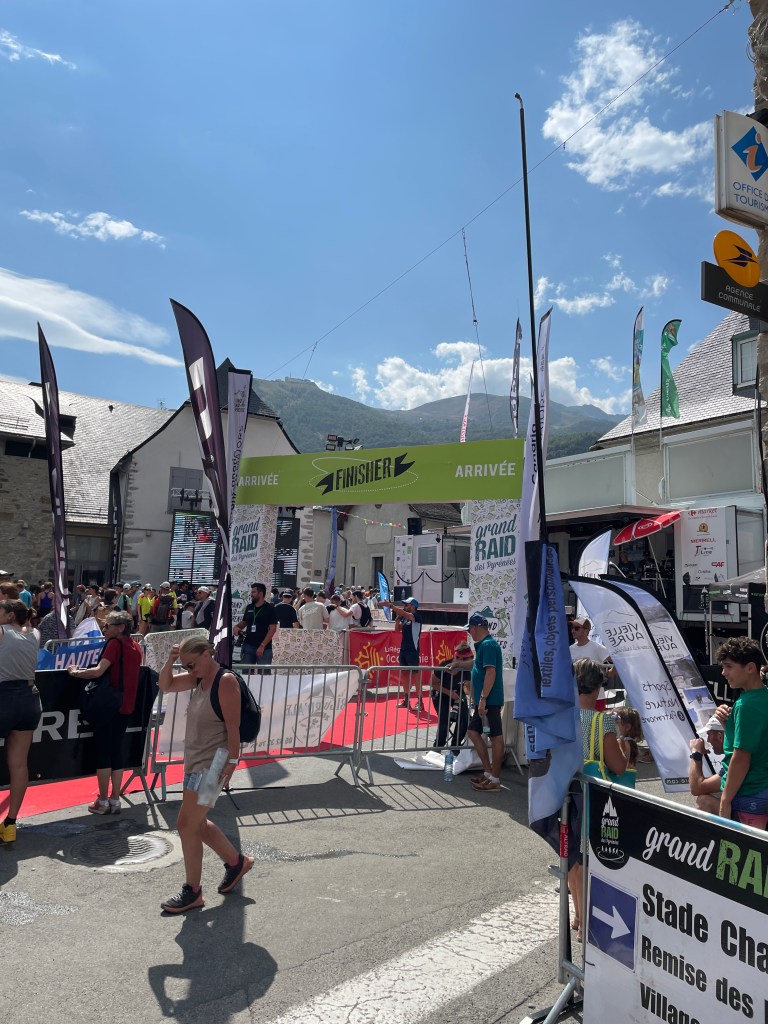
The rest of the day was pretty relaxing. I also finalized my plans with Julien for the first technical objective of the trip, which was Aneto (the highest mountain in the Pyrenees) on Monday-Tuesday.

The following day we relocated to my great-aunt and great-uncle’s house in Grailhen, which is situated at about 1100m and was in a beautiful spot. The plan was to stay here for the following week before returning to Barcelona to catch my flight, with one or two nights spent in the mountains. Most of the family left by the end of the day to head home, save the folks who lived near Paris and had an eleven hour drive ahead of them.

Days 4-5 – Aneto Summit Attempt
I packed my gear up and headed down to the gondola station parking lot in St. Lary-Soulan to meet Julien. I first picked up some food for breakfast and lunches, and withdrew some euros for the bus to get to the trailhead. The drive to Benasque, the closest town to the mountain, took a couple of hours and we stopped for lunch and a coffee in town on the way. Benasque looks like a great base to tackle many objectives in the Spanish Pyrenees, and I’ll probably stay here next time I visit the Pyrenees.

We drove to the bus stop at Vallibierna in order to catch the bus to the Refugio de Coronas, where the climb would begin. In peak season, personal vehicles are not allowed to drive to the refuge and one must take a bus instead. The trip, which took about 35 minutes, involved some skillful maneuvering by the bus driver on a fairly narrow road with a precipitous drop off to the right. Plenty of beautiful mountains could be seen off to the south across the valley.
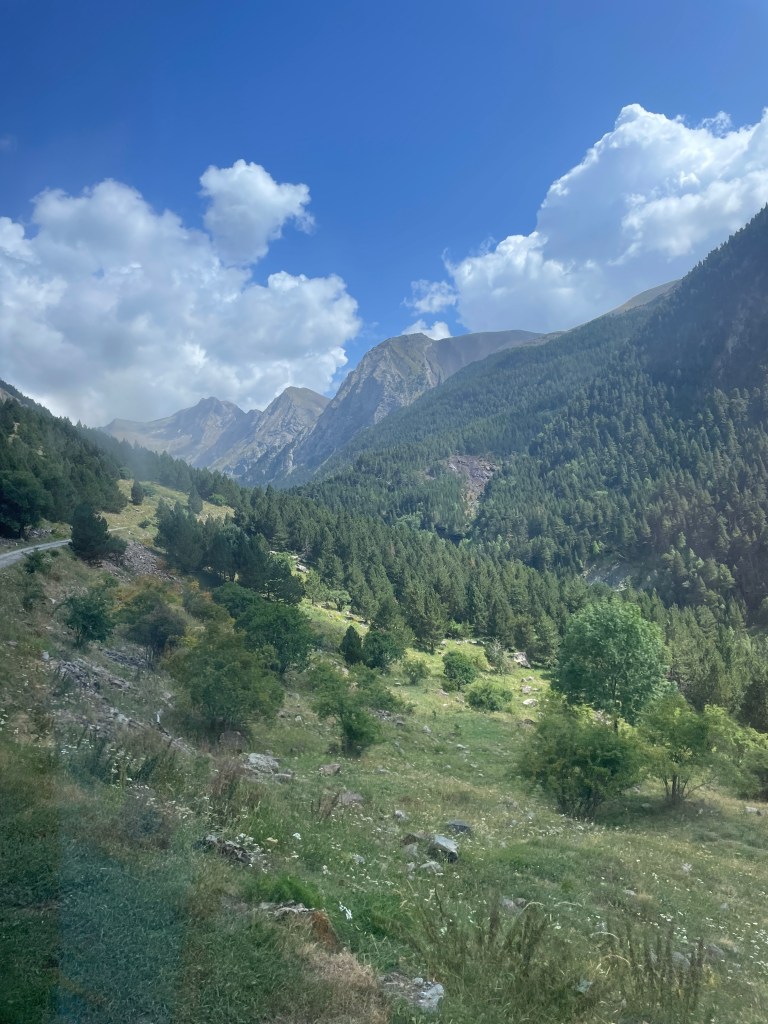
Upon arrival at the refuge, we began the roughly 2.5 kilometer hike to our camp, which was a bit lower down than the typical campsite location for Aneto attempts, as we would be taking a more unconventional, technical route. The hike started off pretty good but after an hour or so I really began to feel how out of shape I was, in addition to not having a strong left ankle. Nevertheless, we made it to our camp in just over 2 hours and Julien began setting up the tarp under which we would sleep. I was happy to take off my boots and plunge my foot and ankle in the cold water of the nearby lake. My ankle was sore but not swollen, which was a good sign as it was likely just fatigued due to not being used much over the last six weeks.
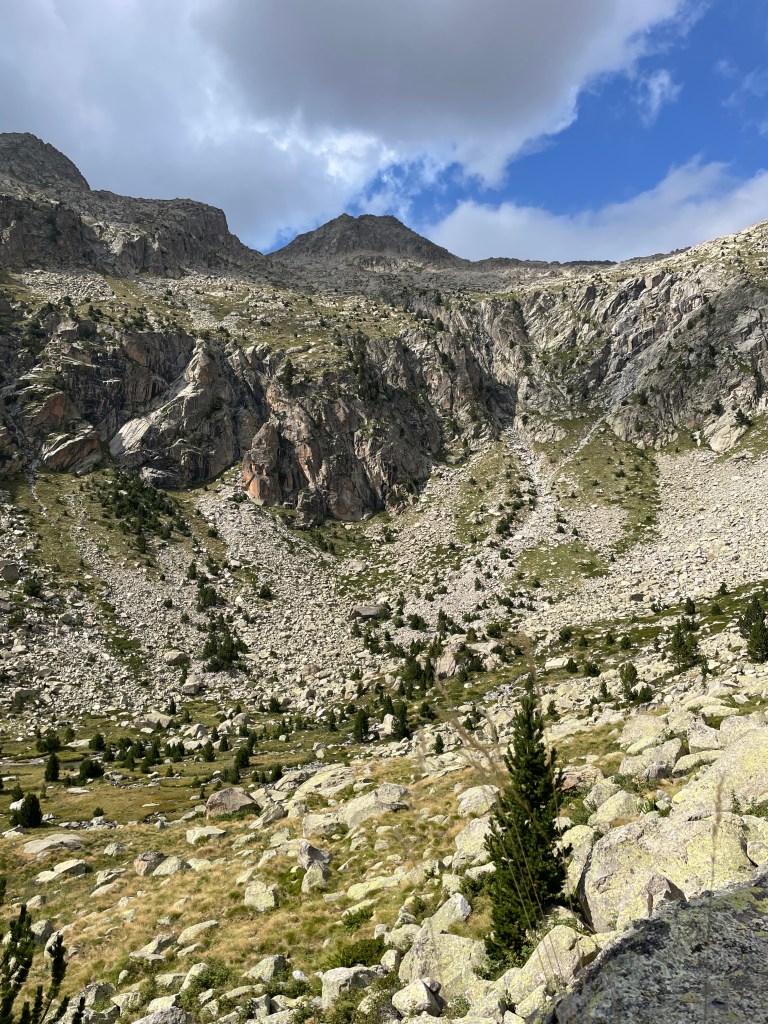
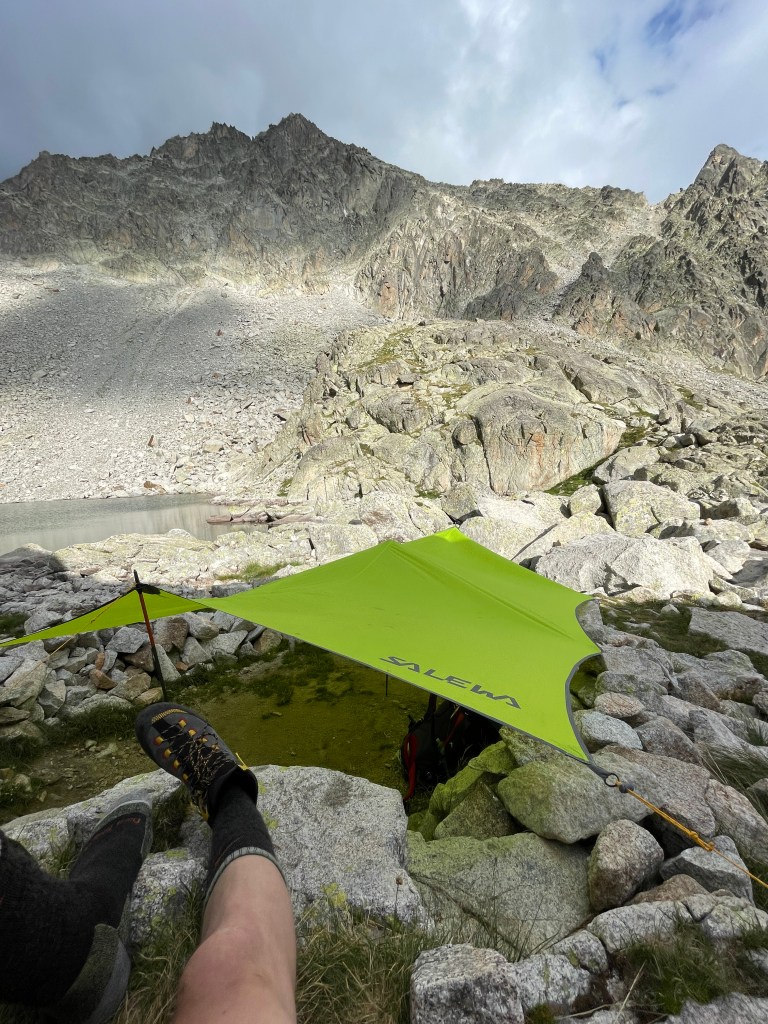
For dinner, we had packaged dehydrated camp meals where hot water is added to the bag, something I had never tried before. It was pretty delicious. We went to sleep around 9pm, aiming for a 5am wake up the next morning to begin our climb. The next morning, after eating breakfast, packing up our camp gear (which would be stashed at the site while we climbed) we set off just before 6am. The route involved first ascending a gully just east of camp up to around 2800 meters. This section, despite being rocky and dark outside, felt pretty good.
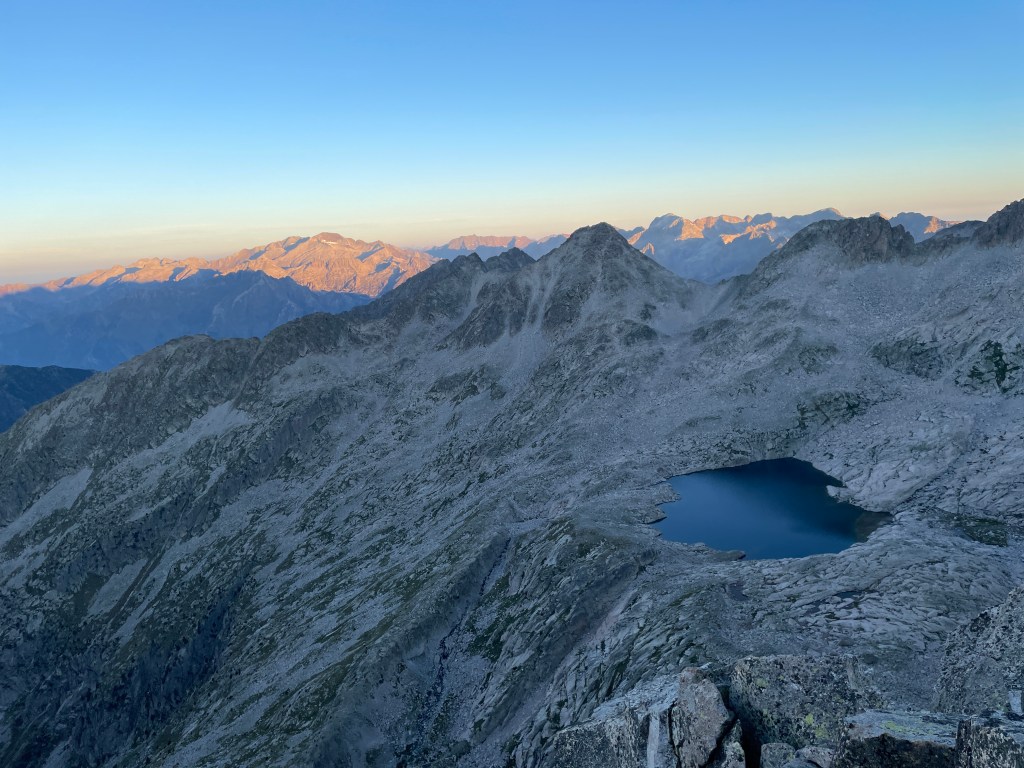
At the top of the gully, we donned our harnesses and helmets, and roped up to begin climbing the ridge that leads to the summit of Aneto. Our route would involve traversing over 5 minor summits:
1. Tuqueta de la Crencha (3032m)
2. Aguja Argarot (3036m)
3. Aguja Tchihatcheff (3052m)
4. Aguja Franqueville (3065m)
5. Aguja Daviu (3350m)

The entire ridge was 3rd and 4th class terrain, as well as a short stretch of 5th class, as well as some rappelling (the first time I forgot to hold the rope at the start, so I dropped six or so feet pretty quickly). While I felt good to start with, I eventually began to struggle and slow down, a combination of my lack of fitness and the altitude (we spent about 4 hours at or above 3000m). It didn’t help that we were on a bit of a tight schedule to make the summit (6 hours from camp, 4 hours to descend) in order to make the 4pm bus back at the refuge (as a last resort, the final bus departs at 6:30pm) so I barely ate or drank anything for any of the ascent. The views were phenomenal, though.
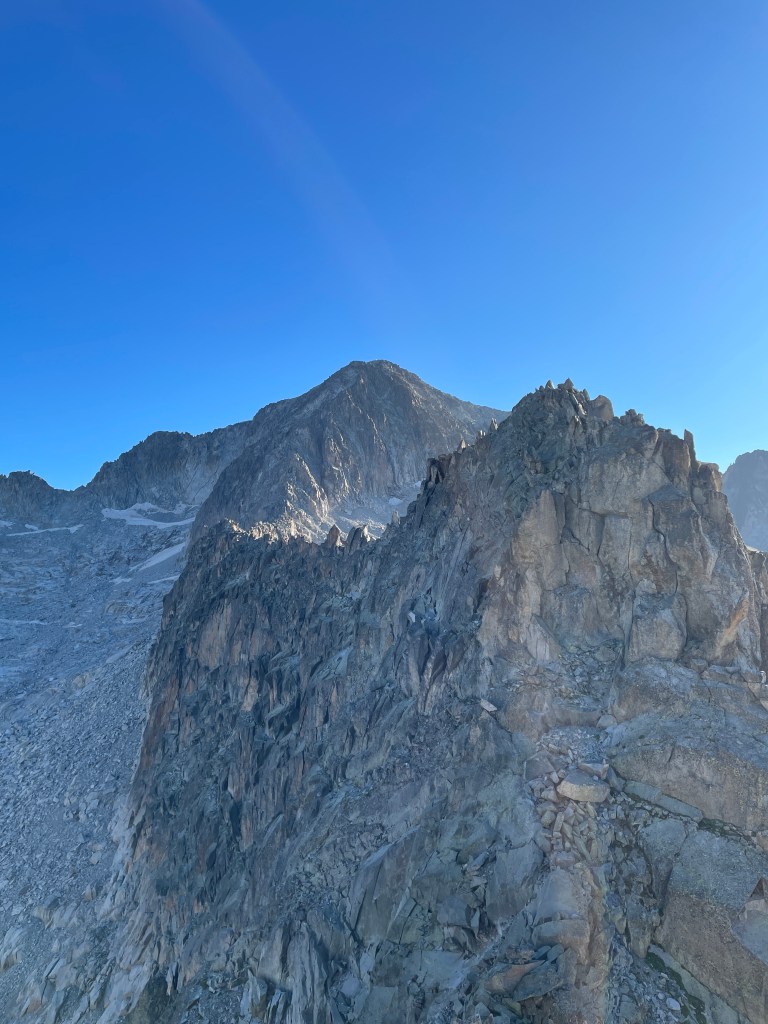
Just after Aguja Franqueville, Julien decided that we would begin descending and abort the summit attempt. While slightly disappointed (more with myself), I 100% agreed with his decision, as I was not feeling great. Julien said that the summit was at least two hours away, and with at least six hours to descend from there, we would not be able to make the final bus and would have to stay another night. Thus, we began the long descent back to the refuge.
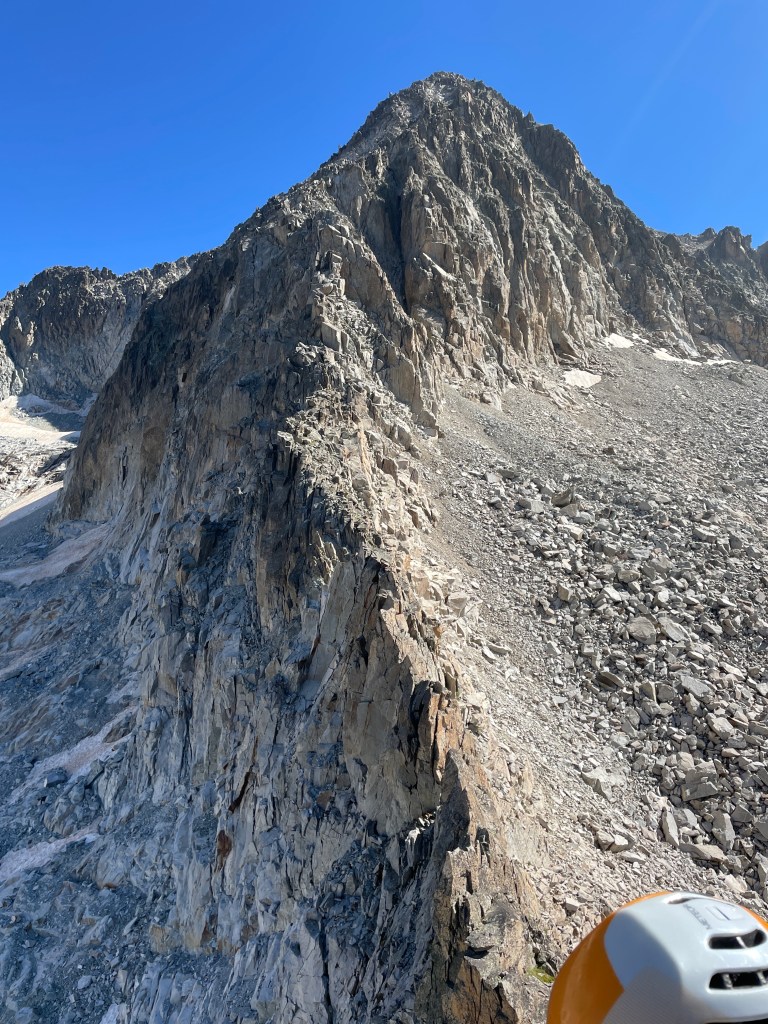
The descent was absolutely brutal and probably the most physically and mentally challenging thing I have ever done. We first did a standard rappel to reach the notch, and Julien quickly evaluated a gully/moraine leading to the “glacier” and decided that an impromptu rappel would be required. He set up an anchor, I tied into the rope and began descending the incredibly loose scree/talus slope, first facing downwards, before shifting to go down backwards. Handholds were hard to come by as the rock was super rotten and I slipped after about 40m, tweaking my ankle a bit, but nothing serious.

After I had descended the full length of the rope, I untied from the rope and was still in a suboptimal spot, with very loose rock under my feet. As Julien began coming down, rocks began to rain down from above and I quickly moved away from the fall line, but was still struck by several rocks, including one the size of a gumball which hit an inch below my right eye. Lucky I didn’t get more severely injured, and also glad I wasn’t wearing my expensive mountaineering sunglasses, which almost certainly would’ve been damaged. Julien’s descent was eventful as the rope got stuck up above and after yanking on it numerous times, he climbed back up to release it, cursing all the way in French.

After reconvening, we began descending to our camp, which involved some route finding through the moraine/boulder field until we reahced the main trail. While my ankle was not painful, I took this section extremely slowly to avoid further injury, and it took absolutely forever to descend 300 meters (1 km of travel). Julien was significantly faster than me and stopped periodically for me to catch up. At the main lake, where folks typically camp for main route attempts, we finally had a chance to eat our lunches at 2pm or so, before continuing to descend to our campsite. Upon arrival and packing up, it was 3:30pm and it was obvious we wouldn’t make the 4pm bus, but the 6:30pm bus was possible. The descent from here was also extremely slow other than a few flat sections – I was completely wiped and the trail seemed to go on forever. Definitely the longest 2km of my life (which took even longer than the ascent, at 2 1/2 hours).
Eventually we made it to the refuge at around 6:10pm, with plenty of time to spare. After another bus ride to the parking lot, we loaded our gear into Julien’s van and began the long drive back to France. After retrieving my car and arriving back in Grailhen, I enjoyed a delicious meal of pasta and scrambled eggs, and went to bed, glad to be safe and relatively uninjured. I somehow avoided further injury to my ankle – the brace was a godsend.
While I was moving very slowly on the descent to ensure I didn’t reinjure my ankle, a huge reason why I struggled so much on this climb was that I was incredibly out of shape, having not done much hiking/scrambling since my injury. This caused me to struggle more at altitude. The lack of nourishment over the course of the climb didn’t help either. Lessons learned for the future.
Hike to Camp (Training Peaks)
Aneto South Ridge Attempt (Training Peaks)

 Veg 'n' Alpine
One thought on “Pyrenees Part 1: Pico de Aneto”