Over 5000 meters above sea level, face numb due to below zero temperatures, wind howling, and breathing heavily, I doggedly took one step at a time on the hard packed snow covering the Jamapa Glacier, each step taking me higher above sea level than ever before. Sleep deprived and mentally and physically exhausted, many times I found myself drawing on memories of my recently departed grandfather. As I soldiered on, I spurred myself on repeating the same lines in my head: “You can do this. Do it for Papé.”
Day 6: The Mountain says No
With the howling winds shaking our tent, the sound of snoring, and in a very cramped position sleeping on my side, it was a relief when Frederick’s alarm went off at 2am. That night was probably the worst I had ever experienced sleepwise, I’m pretty sure I got no sleep whatsoever. Frederick, being in the awkward location in the tent, got up partway through the night to shore up his side of the floor space and also secure the tent a bit more against the wind.

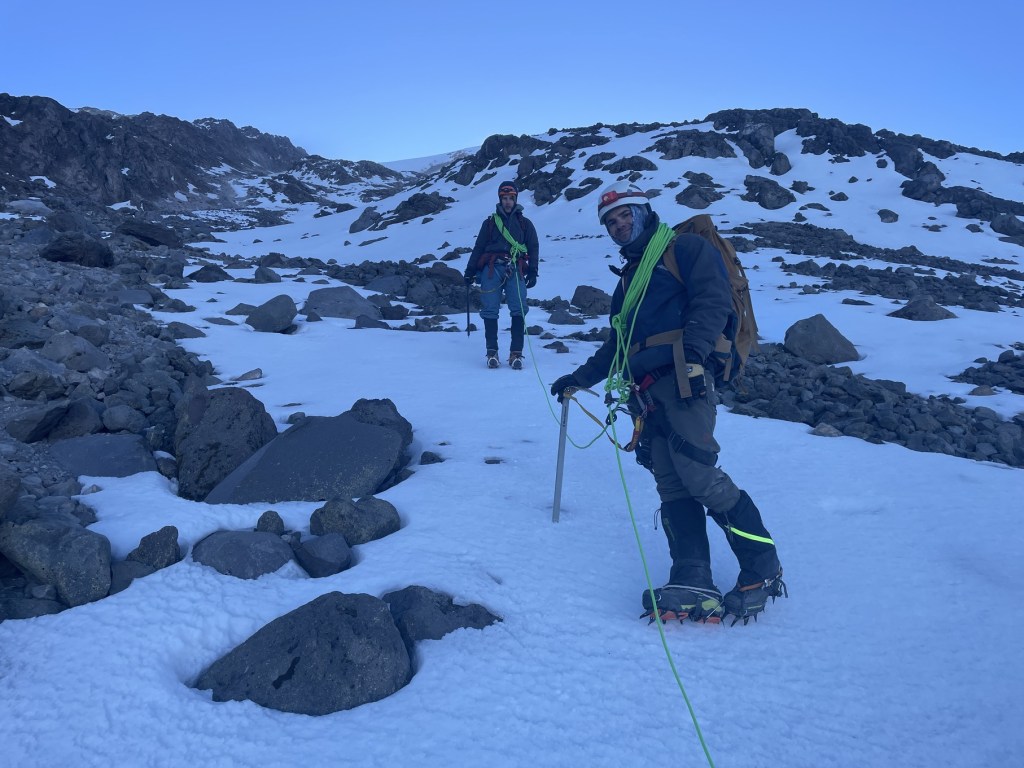
We were on the trail at about 3am. After roping up, we quickly made it past our previous high point up a moderate snow slope with a hard crust. Upon cresting the first ridge above the first snowfield, it was still too dark to properly see the route ahead, but it was very clear that the snow cover was extremely sporadic, and there were a lot of rocky sections to navigate. We were able to stay on the snow for the most part, but the terrain became very steep in places. Not an issue as we were properly fitted out in crampons, but definitely not what Frederick was expecting (older photos showed a long, steady slope of snow, unlike what we were currently dealing with). This section probably was the biggest test for my ankle – it was rolled outwards for large stretches but since it was pretty gentle loading, I felt pretty good overall. Honestly, my uninjured right ankle was a bit more stressed.
It was pretty slow going overall. After one extremely steep slope (which Frederick and Luca climbed “ice climbing” style as it was about 70 degrees – I just side stepped it and stayed upright), we stopped on a rocky ledge while Frederick went ahead alone to scout the next part of the route. We were at about 4900 meters, still about 700 vertical meters from the summit, and we had been climbing for about four hours. The sun was starting to come up, providing us with great views of the area west of the mountain as well as neighbouring Sierra Negra (4566 meters).
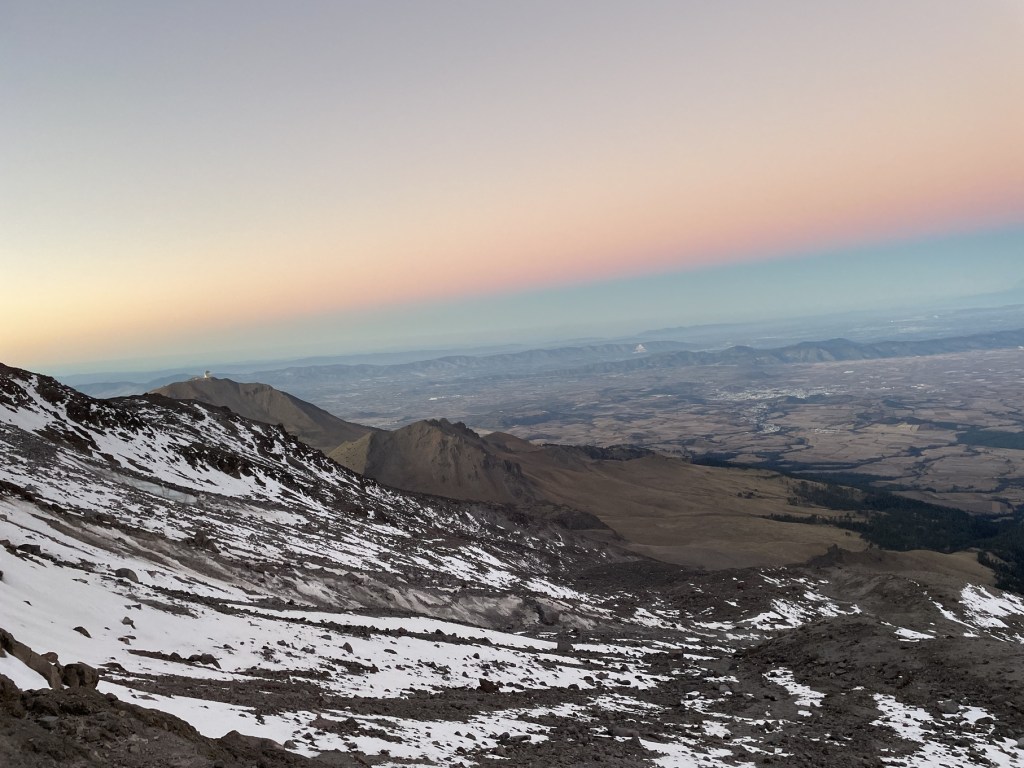
It took Frederick some time to find his way back (our voices echoing made it a bit confusing) but when he did return he indicated that things did not look any better on the slopes above. We traversed a short way over to the north and observed a mostly loose rock slope, with a small amount of snow, and overall, it was VERY steep. A bit further away, rocks were tumbling from the slopes above, and it was only 7am (generally, conditions become a bit more dangerous as it warms during the day – it was alarmingly early to see rockfall). Frederick indicated that given the risk level, we would be aborting our attempt, and we would aim for an ascent of Orizaba via the standard route in the next few days. The route was definitely climbable, but if it was climbed, being unroped or ascending fixed ropes would probably have been the correct course of action (as self-arrest would be nearly impossible, if one of us took a fall we would all likely go down with him). It was a bit disappointing but completely understandable. We then began our descent, which was a bit easier than the climb, but still required a lot of focus to get good purchase with every step.

Upon return to our campsite, we discovered that the wind had blown in a ton of dirt and dust under the wall of the tent and coated our sleeping bags and pads. Thankfully, Frederick, had partially rolled up our bags before we left, so nothing got into the sleeping bag itself. This place was ridiculously dusty!

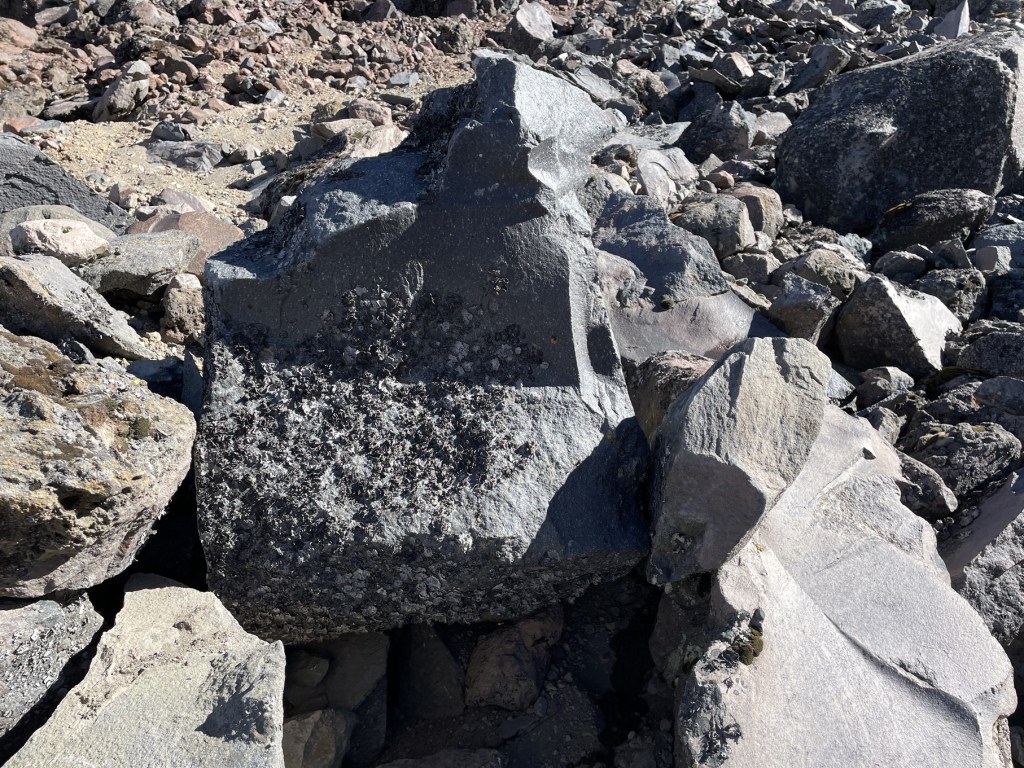
We took a short breather before beginning to pack up. At one point, while reaching over to grab my Hydro Flask, I leaned on a large boulder, which suddenly shifted, causing two smaller rocks to fall down towards my trekking poles. I heard a crack and my heart sunk as poles were integral for me to descend safely (or at least give me some peace of mind). It turned out that one of my poles (LEKI, my second pole was a Black Diamond – I had previously broken the other in the pairs) had fractured, though it wasn’t a clean break, so Frederick mused that it might be salvageable once we got back to Hildago. While this was annoying, we got a good laugh at the fate of my Hydro Flask. It had fallen when the rocks dislodged, and the large boulder had landed squarely on top of it, pinning it in place and not appearing to damage it otherwise. After packing up camp, Frederick lifted the rock slightly, which unloaded the bottle. I then inserted a wedge-shaped rock into the gap to arrest further movement of the boulder and allow me to grab my bottle. While a bit scuffed on its lid, the bottle was still in great condition. Hydro Flask bottles are pretty solid (literally)!

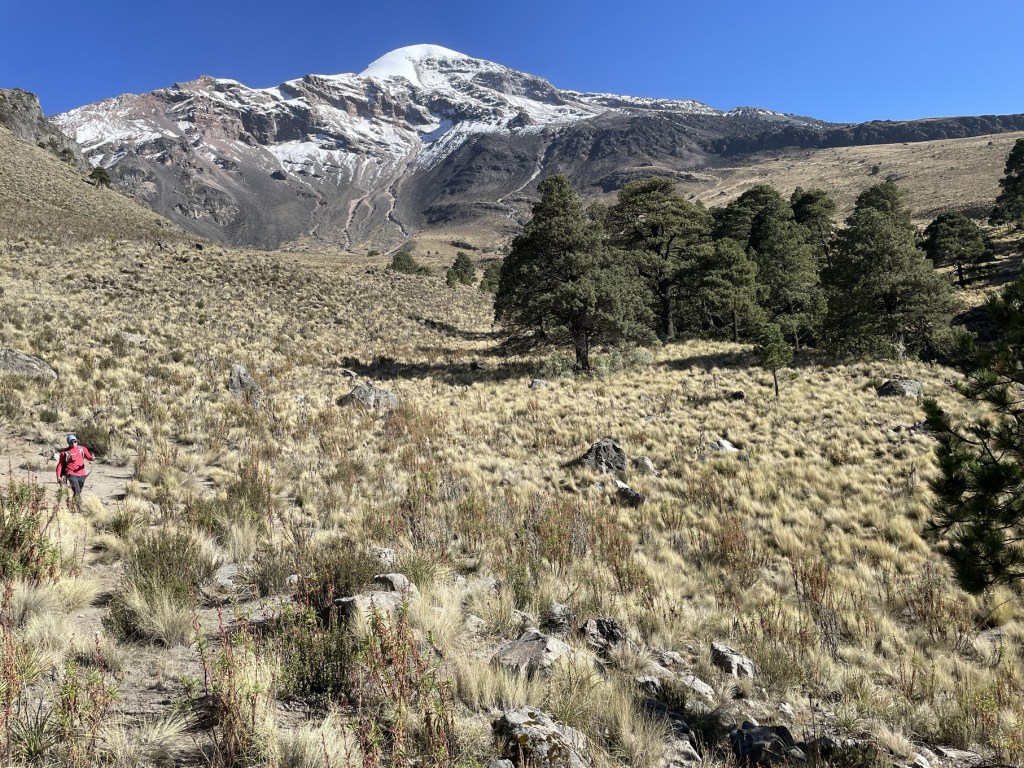
Frederick contacted Rafael via Whatsapp at high camp to see if the horses could come pick us up that same day (the original plan was for them to come the next morning as we expected a full summit day). Upon arrival at camp, we discovered the horses were on their way, so we had a hot lunch and quickly packed up camp. I opted to ride a horse the whole way back to Hildago as I wanted to preserve my ankle for our subsequent attempt at the standard Orizaba route, and Frederick and Luca each rode half the trip (which took about two hours in total). The route was quite scenic, though uncomfortable in the saddle, especially on the uphills and downhills. It had probably been at least 20 years since I rode a horse.


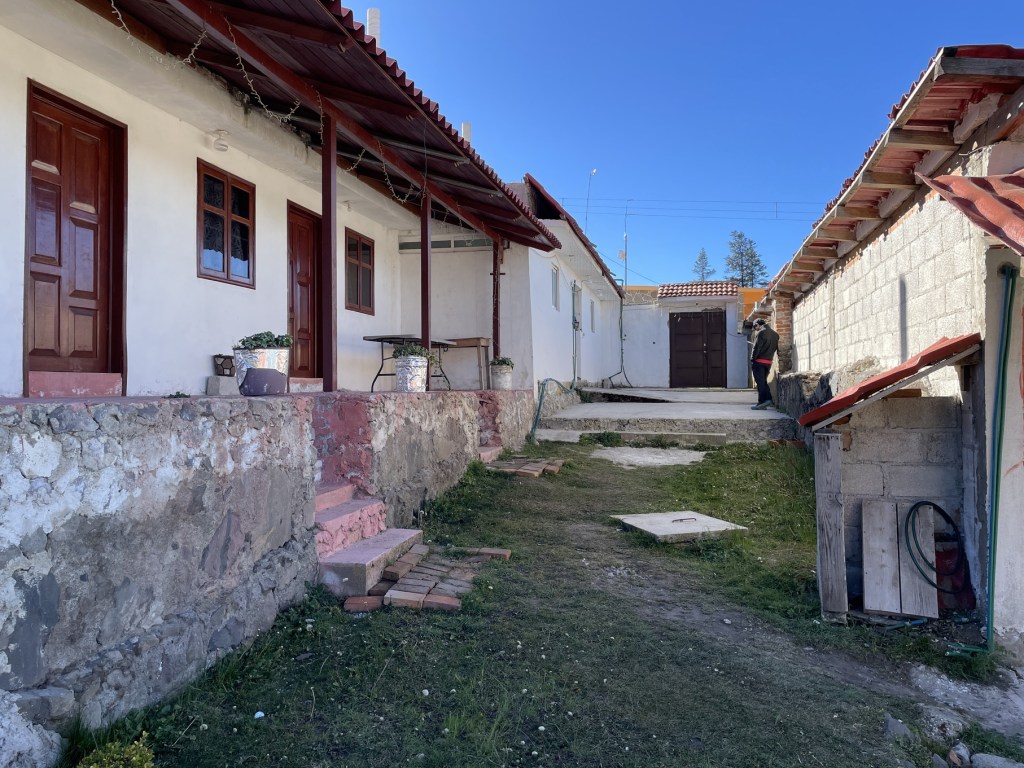
Upon return to Hildago, my hip flexors and adductors were super stiff and I had some trouble walking for a bit. While we were waiting to get onto Rutillio’s property, I noticed a dog skulking around and getting close to the three of us. Noticing that it was peeing on everything, I presumed it was a male dog marking its territory, and made sure I was aware of its position at all times so that it wouldn’t pee on my leg. Well, it actually ended up peeing on Frederick’s leg when he wasn’t looking. which he wasn’t super pleased about, though we all got a kick out of it.
When we got back inside, we tried to clean our dusty gear as best we could. Frederick tried to do a makeshift repair to my broken pole by duct taping a tent stake to it for support, but the stake was made of aluminum so it bent when he tested the repair by loading the pole. I intended to throw the pole out, but Frederick thought he would take it to do a proper repair when he got home – he mentioned it would be a good thing to give to his son’s friend (who thinks Frederick is super cool). After a huge dinner and shower (the water was lukewarm and the bathroom was freezing, so I have never shivered more intensely in my life), I was in bed around 8:30pm as I was super exhausted.
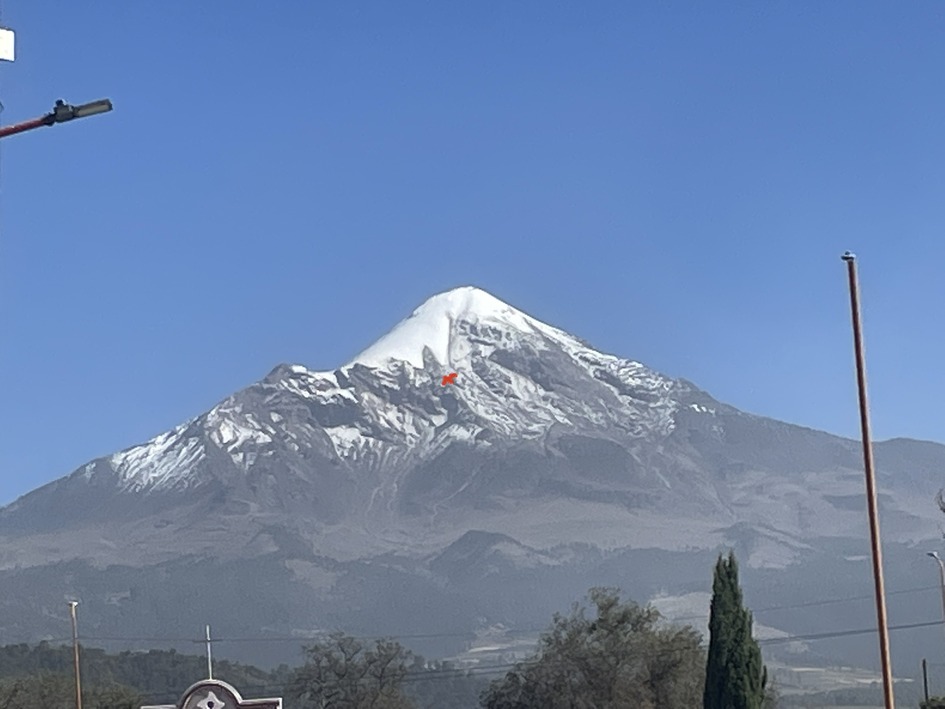
Day 7: Pivot to Standard Route
I slept nearly 12 hours, and felt significantly better the next day. There was a bit of strife between Frederick and Rutillio surrounding all the issues we had dealt with thus far on the trip (inability to reach our desired base camp, quality/feasibility of the route, as well as no access to running water at camp). Rutillio was actually threatening to kick us off of his property, but luckily we were still on great terms with Rafael, and Frederick’s friend back in Canada helped greatly with smoothing things over.
We went with Rafael to Ciudad Serdán, the next furthest town from Tlachichuca, so Frederick could withdraw sufficient funds to pay for the horses – the bank machines in Tlachichuca had a withdrawal limit. In Serdán, we visited a cathedral (San Andrés), had lunch, and wandered around a bit. Upon returning back to Hidalgo, we packed up to head to the Refugio Piedra Grande, from where we would make (hopefully) a successful ascent of Orizaba the next day. While packing, I noticed my mom wanted me to call her as soon as possible, and she shared the tragic news that my paternal grandfather had passed away the previous day. He was definitely on my mind the rest of the day (and trip) but I decided to use my memories of him as fuel for the hard summit push that lay ahead.


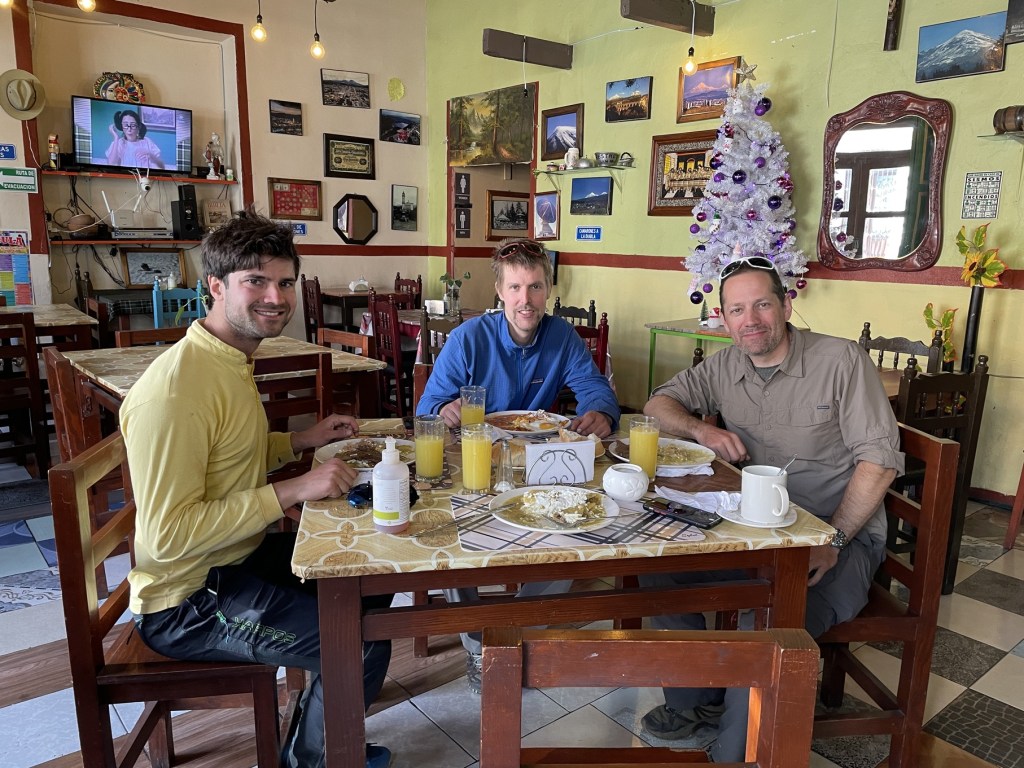
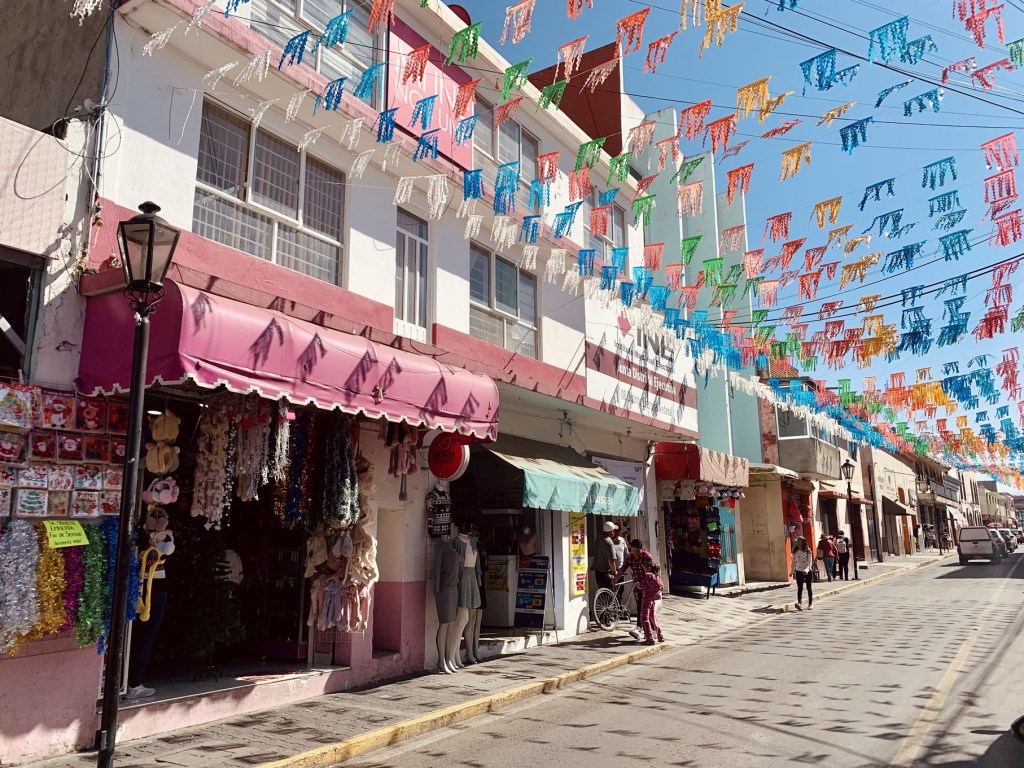
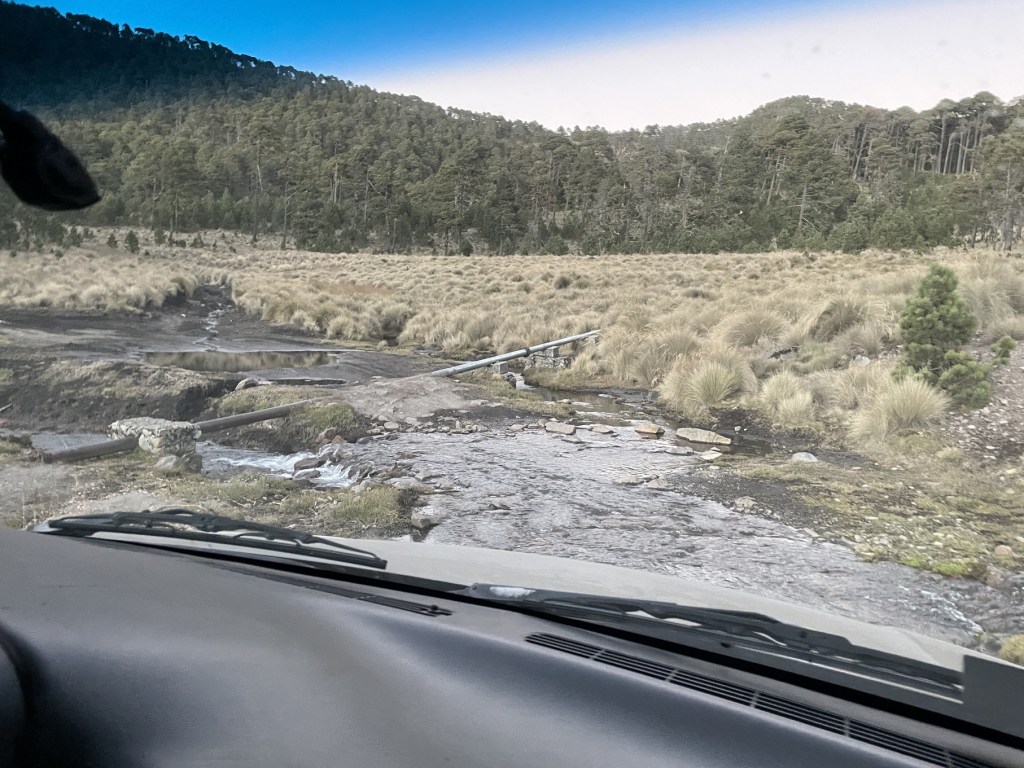
We left Hidalgo at 5pm and it was dark (and very windy) when we arrived at the hut at around 6:45pm. The road was very bumpy and at one point Rafael exited the truck (yes, the same one that got stuck before) to create a makeshift bridge across a section that was flooded. We could see headlights up on the glacier and were very surprised people were still on Orizaba in the evening (people generally start very early in the morning).

Upon arriving, we quickly set up our sleeping bags and quietly had dinner which was predominantly snacky food. Frederick pulled out a bag of tortilla chips and Rafael provided canned tuna to dip the chips in. We were off to bed at around 8pm, with the goal to get up at 1am to begin our climb. Rafael would remain in the hut to keep an eye on our stuff.
Day 8: Summit Day
It was a pretty short rest that evening as the other teams in the hut began rousing just before midnight. We ended up getting up just after midnight and fired up the stove for a quick meal. There was a bit of anxiety as the other teams began filing out, leaving us behind, but I was confident we would be in good shape as this was an established route, the conditions were forecasted to be good, we were very acclimatized, and we had a very experienced guide leading us. We got on all of our layers and were out the door around 12:30am.
I like to think of the climb as split into four stages – pre-Labyrinth, the Labyrinth, lower glacier, and the glacier. Most of the ascent was done in the dark and things were simplified quite a bit mentally as we could only see a few meters in front of us, illuminated by headlamp (the moon was actually a blood crescent moon, so not much natural light to work with). The start was a good strong hike through moderately steep terrain and served as a great warmup. Luca wanted to go a bit faster but Frederick and I kept the pace a bit lower – I definitely needed it due to my overall lack of sleep (15 hours total) over the last three nights. We overtook a couple of the other parties in this part of the climb, so we made great time to the Labyrinth. This section is notorious for (as its name implies) its many dead ends and difficulty in following the trail. However there was a very easily defined bootpack trail to follow through this section – very different to when Frederick last climbed Orizaba prior. Just before entering the Labyrinth, we donned our crampons and took out our ice axes. At this point I probably should have put on my harness as well – keep that in mind for later.
We got through the Labyrinth with ease and emerged from it only a couple hours after we left the hut. The lower glacier (largely a mess of talus/scree, boulders, and snow) was tricky to navigate in the dark due to all the ruts and gouges, and we had to double back in some places to get onto the glacier proper, as we veering off to the right towards Sarcófago (a rocky subpeak north of the main summit), at times. Eventually, it got sufficiently steep that we decided it was time to rope up. It was extremely awkward as I did not have my harness on yet and it was tricky to put on my harness when wearing crampons as I needed to step into it. It was here that several of the parties behind us started to overtake – many people opted to not rope up for the climb up the glacier.
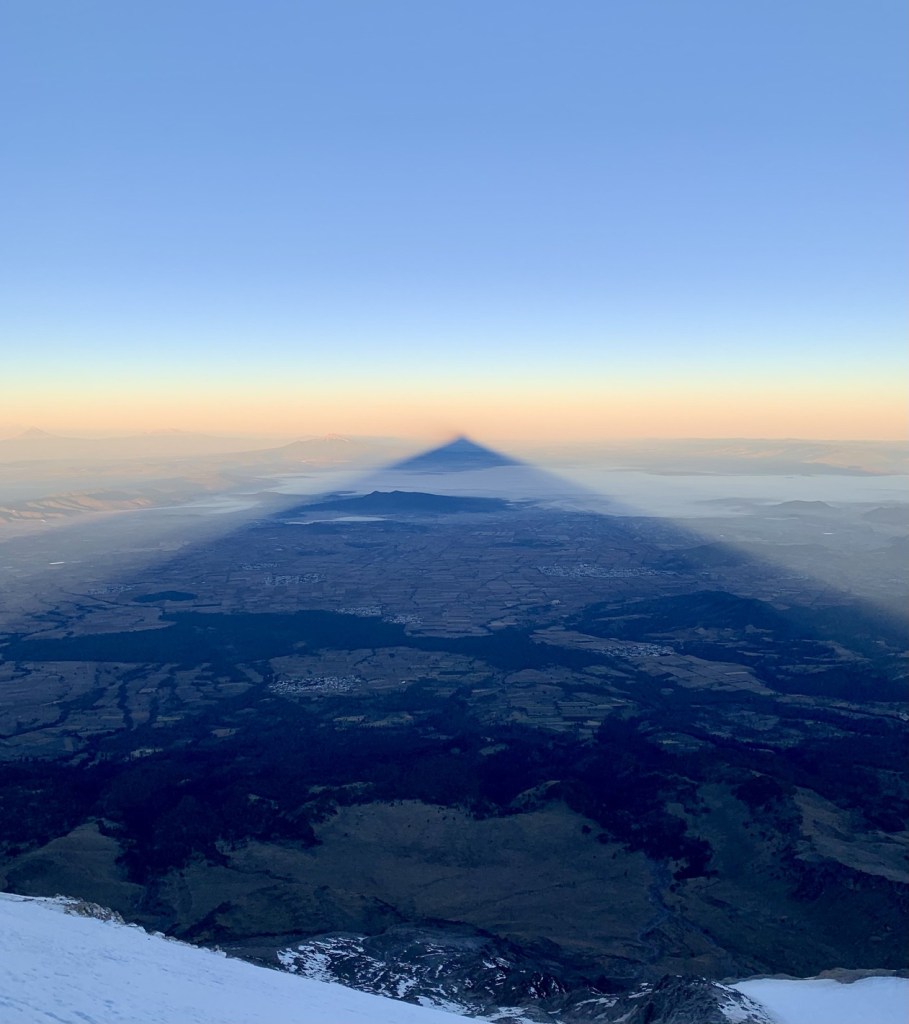
Thankfully, there was a solid set of switchbacks up the Jamapa Glacier to follow (we could see these from Hidalgo), so travel, while slow, wasn’t terribly complicated. It was definitely a long slog, with one step at a time being the focus. I could definitely feel the added difficulty of taking each step due to the terrain, thin air, and fatigue, but I felt pretty good otherwise, no symptoms of altitude sickness as we went above 5000m. The sun finally began to rise around 7am, and it was truly a marvellous view. We stopped briefly to take pictures of the shadow of Orizaba cast into the valley below.


The glacier ended and the summit “ridge” (edge of the volcano caldera) was composed of areas of loose rock as well as snow. It was super windy here but the travel was more or less flat at this point. The view into the caldera was pretty breathtaking. This wasn’t the first volcano I’d climbed, but it was quite something seeing the crater drop out of view below. After a few more laboured steps, we finally reached the summit, the highest point on the caldera rim, at around 7:30am. I was super wiped and while the pictures do not show it, I was super stoked (as were Frederick and Luca) to have finally made it to the summit after all that we had gone through the last few days. Definitely better than no summit at all and well worth the journey!
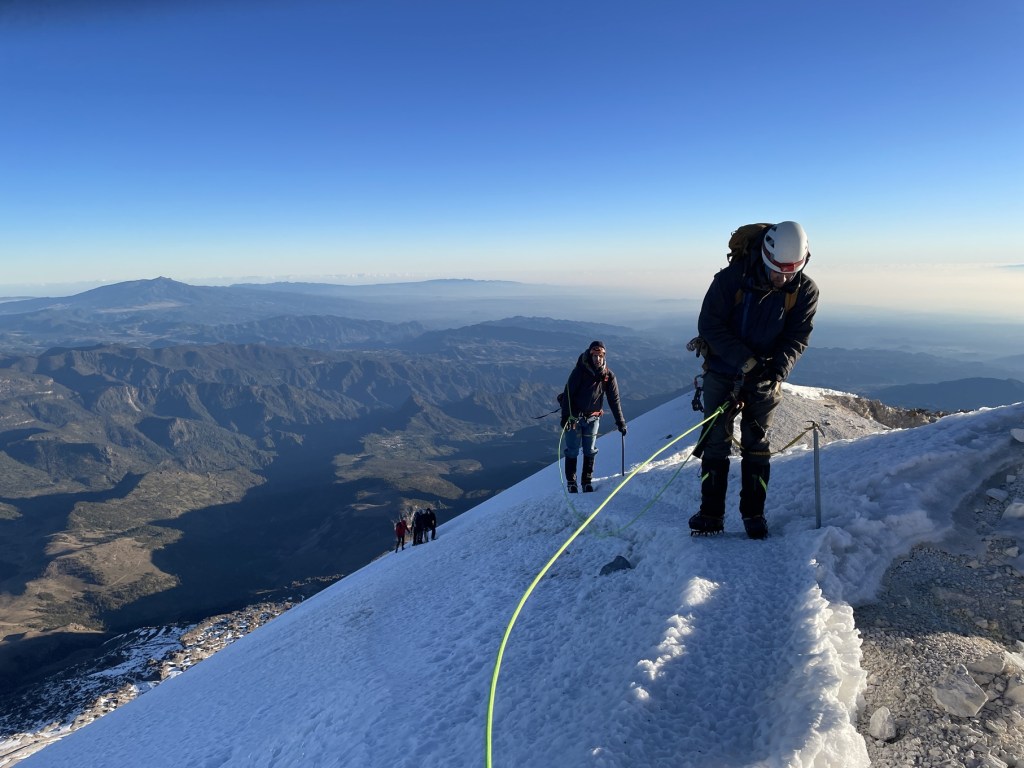


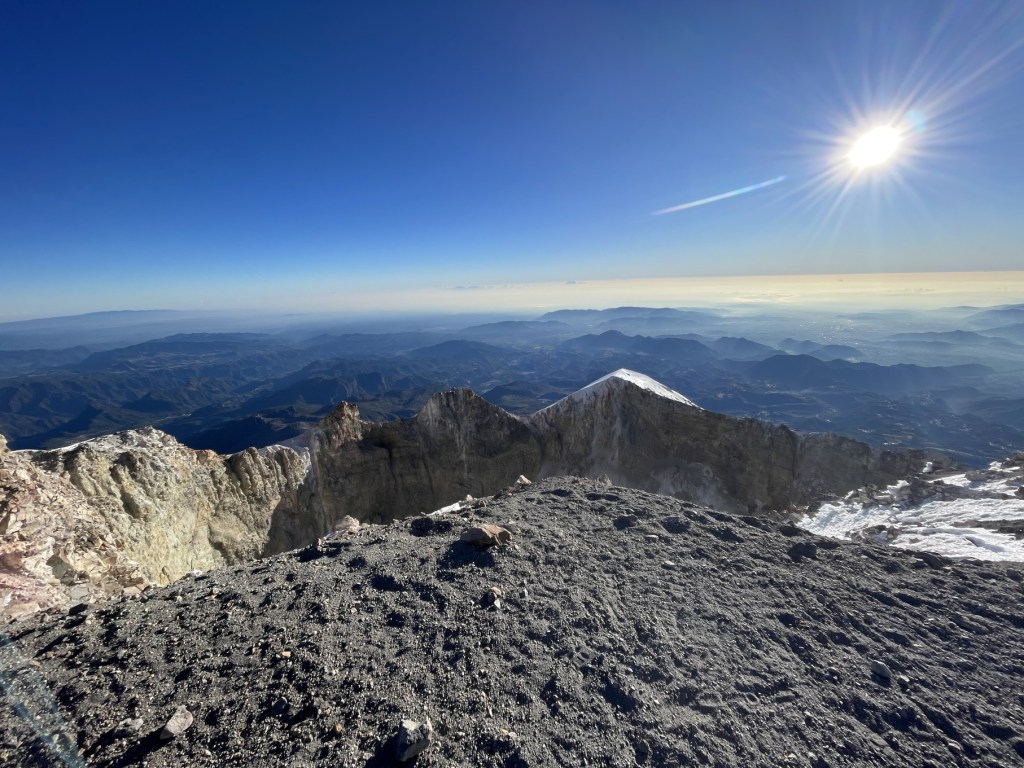

The summit was uncharacteristically windy and cold. Frederick mentioned it was the worst he had ever experienced in all of his summits – on his previous climbs you apparently could unrope, sit down and enjoy your lunch on the summit! So, we didn’t spend too long here, just enough time to take some photos then we immediately began our descent. It was overall a bit easier than the climb up, though I did need to take a short breather on one particularly long switchback (in which my left quad got super fatigued). Sarcófago looked so tiny from above, despite towering above as we traversed the lower glacier.
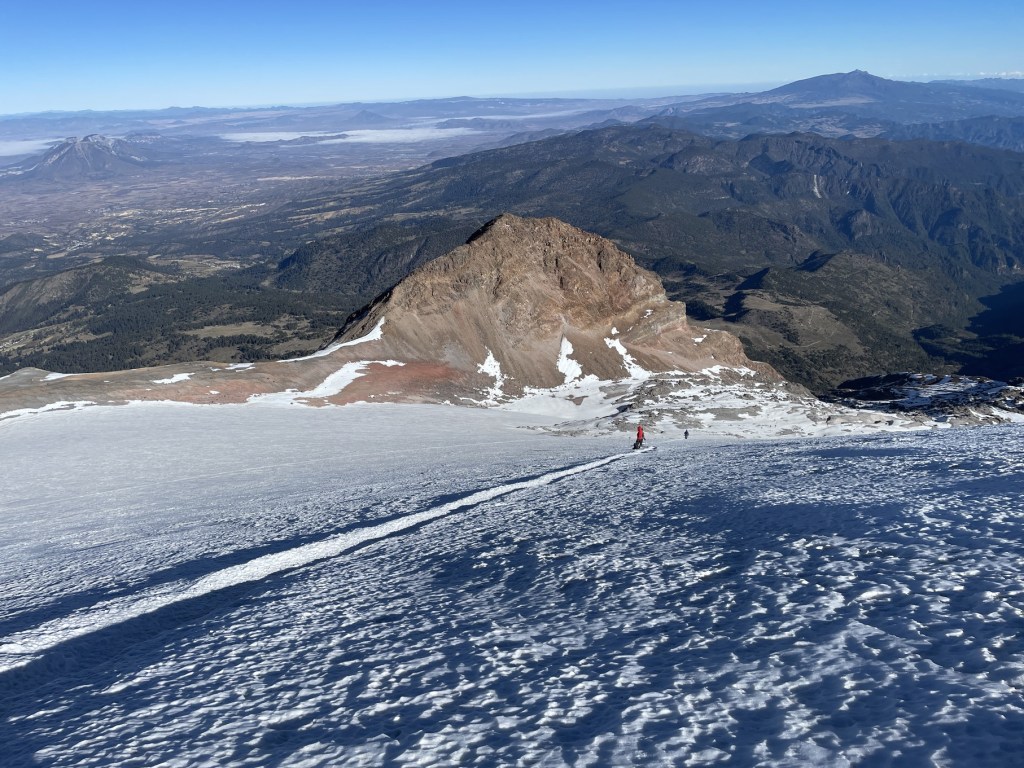
We were moving pretty slowly to be safe, and another pair of roped climbers decided to hustle past us by jumping off the switchbacks briefly. I had a funny feeling when I saw them begin to overtake me, and all of a sudden, one of the crampons of the trailing climber popped right off his heel. I yelled out “CRAMPON LOOSE!” which startled Luca, but fortunately the climbers were able to stop and address the issue. It looked like that climber did not have the best compatibility between his boots and crampons, which just seems crazy to me that you wouldn’t have your gear dialed in on dangerous terrain (even though Orizaba is considered an easier snow/ice climb, people have fallen and died on the Jamapa glacier in the past).
We finally made it to the bottom of the main part of the glacier and took a snack/water break, and also unroped. I had barely had anything to drink all morning and was incredibly parched. It was tricky not having easy access to my bottle without taking my pack off – note to invest in a hip pouch or a bladder for next time. The next part of the descent wasn’t too bad but the fatigue really started to catch up, not to mention that while it was great the sun was out and it was getting warmer, I had to remove a lot of layers to avoid overheating. This could only be done on my upper body as I still had my crampons on, so removing my lower body layers and gaiters wasn’t really an option (I guess I could have taken my crampons off temporarily, but I was too tired to remember that, let alone actually do it).
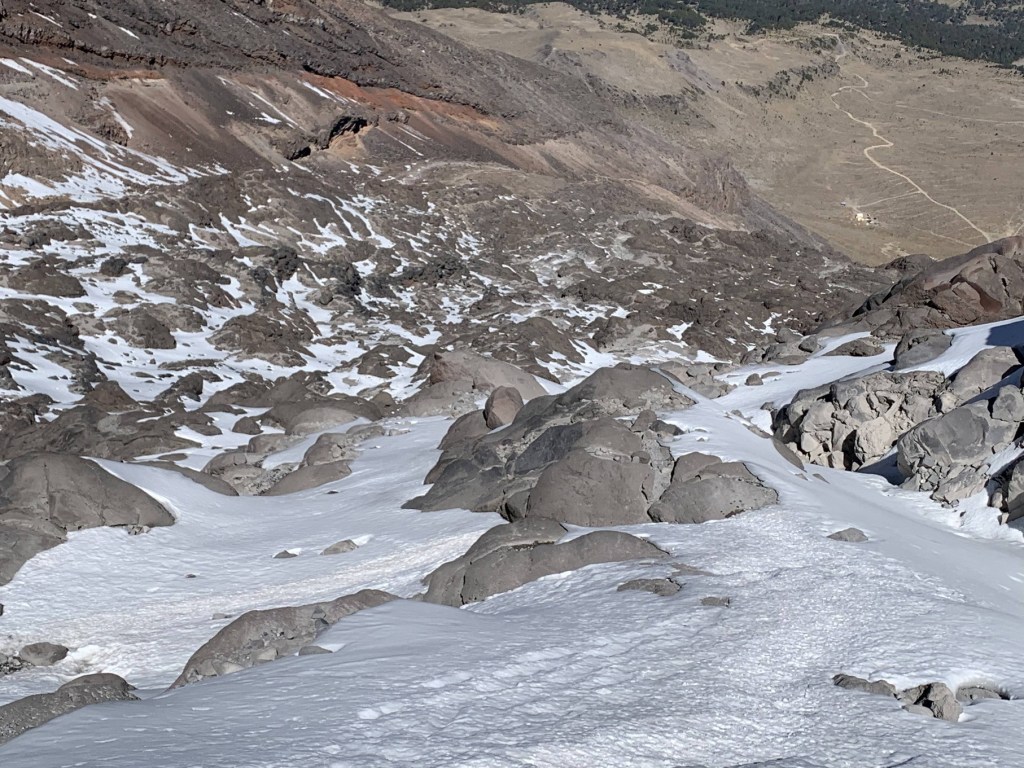

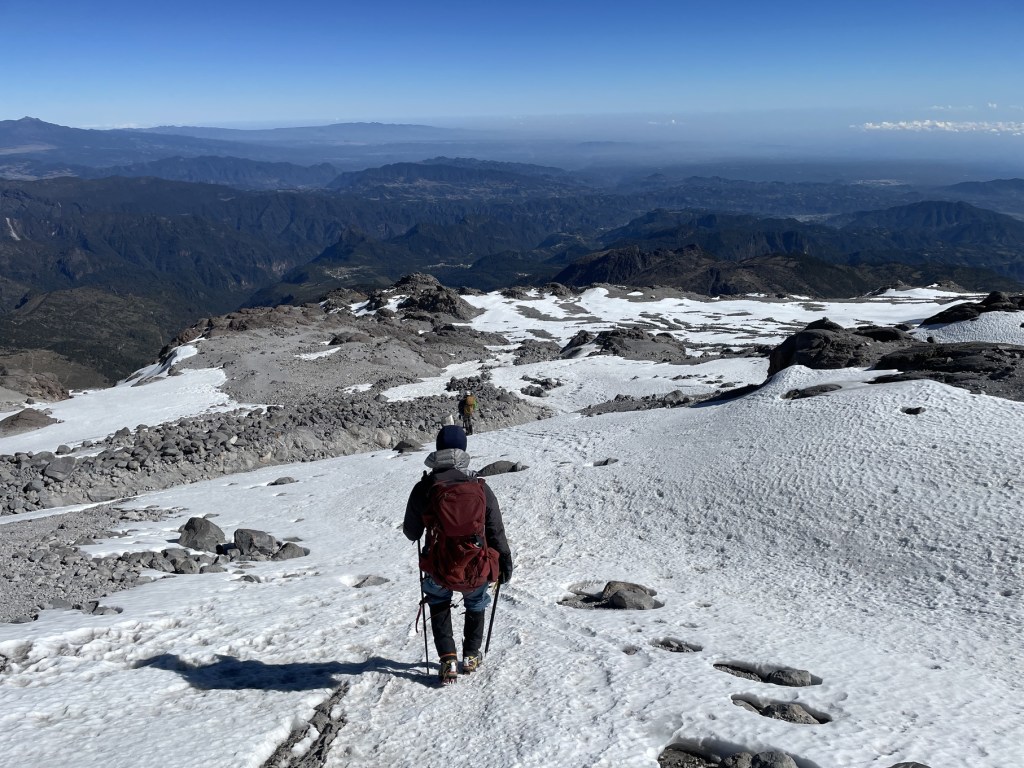
The Labyrinth was incredibly long and seemed to go on forever – it probably took longer to descend this section than ascend. Towards the end, I was overheating quite a lot and once we got to the end of the snow, I frantically removed the vast majority of my clothing (save hiking pants and underlying base layers) and chugged a ton of water to cool down. After a short break, we resumed our descent which was a bit on the slower end – it was a bit surprising to see how steep the lowest part of the trail was from above and in daylight. Frederick noted that the trail took a slightly different line than what he took in the past, due to the rockfall and landslides that had appeared to occur on climber’s left. Indeed, looking at OnX, the marked route is no longer possible as it went through this collapsed area. We took our time and finally made it back to the hut where we were greeted by Rafael. Hut to hut in just under 11 and a half hours, about 4 hours 45 minutes to descend from the summit.
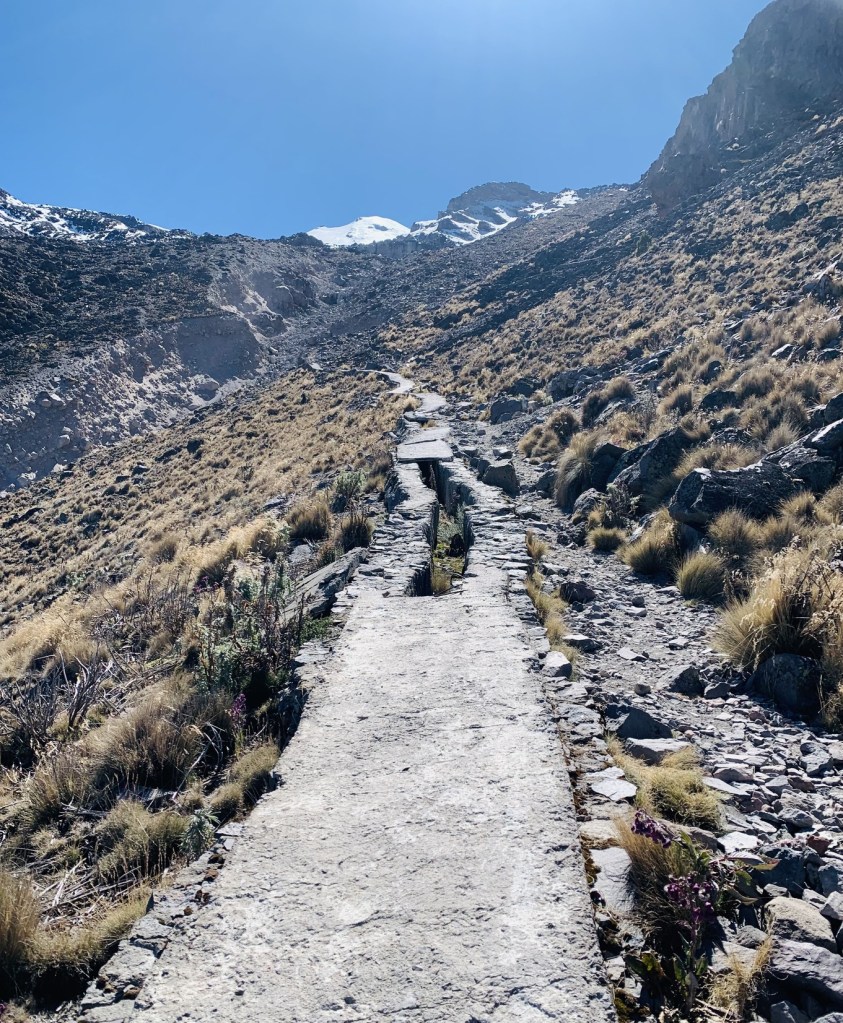

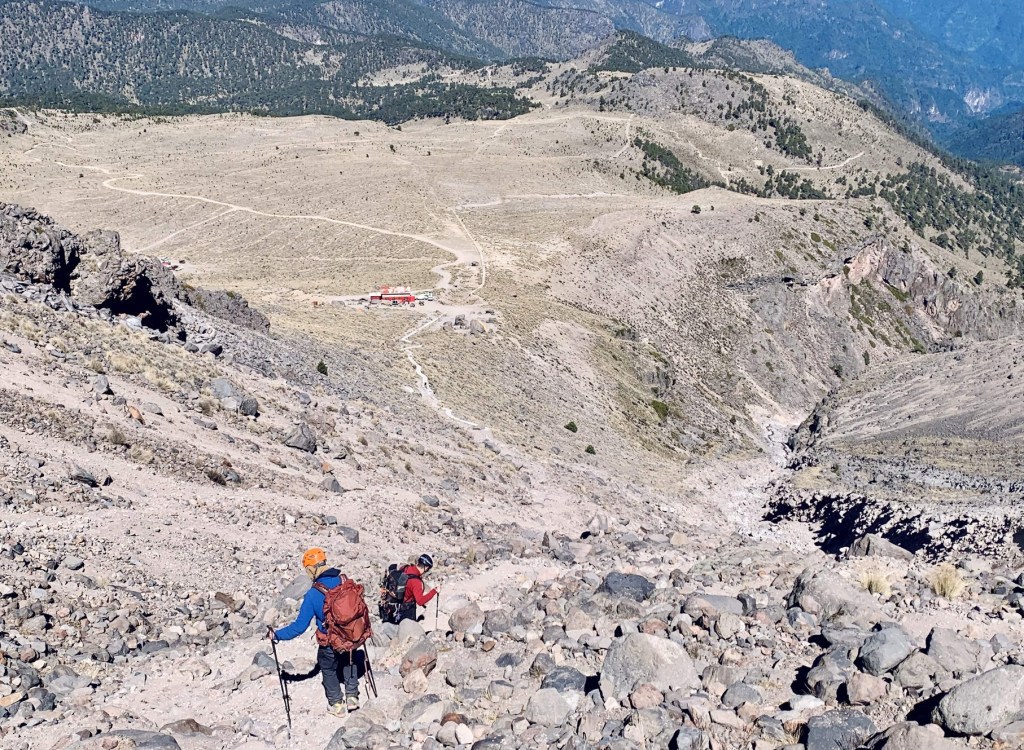
We relaxed at the hut for about an hour before packing up, enjoying a hot lunch and chatting with other climbers in the hut who were planning to head up the next day. We were all super exhausted but overall very happy with how things turned out. Frederick joked that he now knows what it feels like to be one of his clients – when he was in his twenties he was able to power up the mountain with no issues!

We returned to Hidalgo with no difficulties, and after relaxing a bit in our accommodations, we enjoyed a wonderful dinner prepared by Rafael and the other kitchen staff. It was then off to bed pretty early again, around 8:30pm.

Days 9 and 10: Touristy Stuff and Return Home
I was up pretty early (probably went to bed too early) and listened to music until breakfast, which was huge and delicious. We then finished up packing. On our way out, the ladies in the kitchen gave us massive pine cones. I’m not sure what the significance of these was, but we see these a lot in Canada (I saw pretty big ones in the Sierra Nevada as well) so it wasn’t super exciting. To avoid offending them, we took the pine cones with us and planned to jettison them at some point.

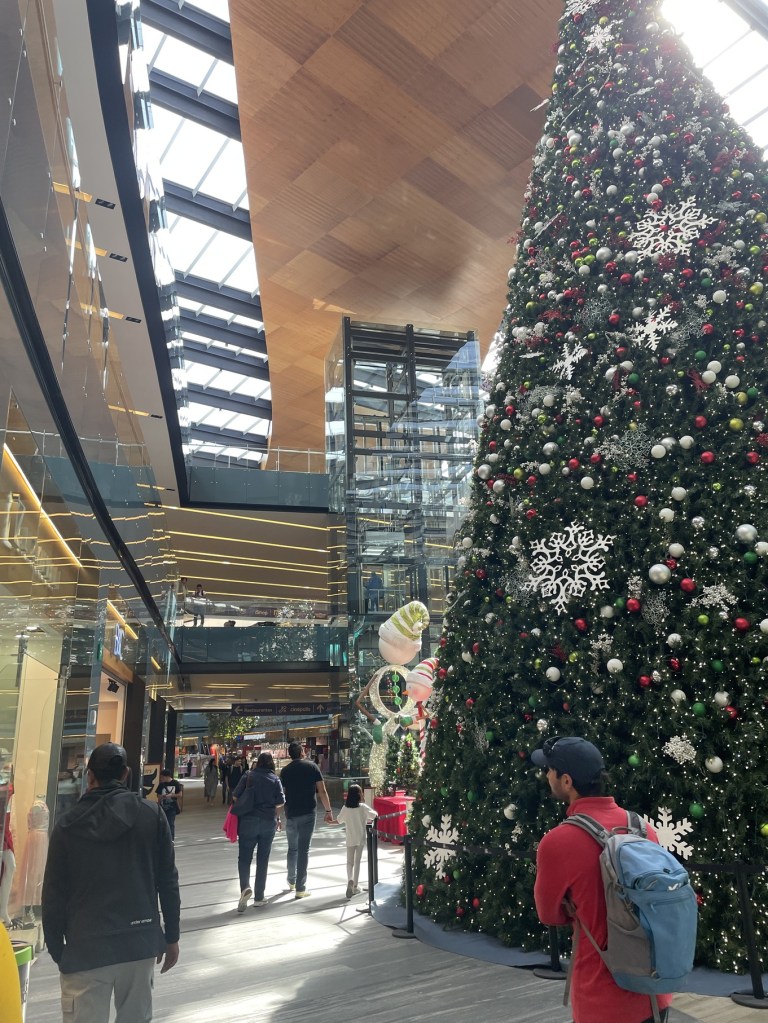
Rafael drove us in a minivan to Puebla, where we would grab lunch and peruse the market for souvenirs. We got stuck in some traffic due to roadworks in San Salvedor el Seco, so it took a little longer than we’d have liked. After parking at a mall in Puebla (which was a nicer mall than anything I had ever been to in Canada), our new driver (who would be taking us the rest of the way to Mexico City), Alejandro, showed up, and it turned out that Alejandro was José (who had driven us to Hidalgo on the way to Orizaba).
After lunch in downtown Puebla, we checked out the market. I’ve bought plenty of souvenirs at markets in the past, so I was less interested in souvenirs and more in some good Mexican rum (“ron” in Spanish). Unfortunately, there weren’t any larger bottles (other than tequila and mezcal), but I bought a collection of smaller bottles of different alcohols for myself and my parents, as well as some dried bugs and a small cat sculpture for my brother.



We were finally on the road to Mexico City around 4pm. The drive wasn’t too bad until we got to Mexico City, and there were some great views of Izta and Popo on the way. Once again, in Mexico City, Alejandro could not drive right up to the hotel, so Luca and I waited in the car while Frederick ran over to the hotel to collect the doorman and the dolly. We disposed of the remaining pine cones (the first one had been covertly left in Rafael’s vehicle) on the way, and after a dinner on the rooftop restaurant at the hotel, it was off to bed.
Final Thoughts
As I sit in my Uber back to my parents place after an uneventful flight home (this section is one of the first written in this post, wanted to reflect asap), I’m overall very pleased with how the trip went. There was a lot of adversity at the start with all the misadventures (huge shoutouts to Frederick for adjusting and staying upbeat) and some down moments for me with a fair amount of ankle discomfort in the rugged terrain during our first attempt, but we persevered and were rewarded with a challenging, but well deserved summit of Orizaba via the standard route at the end. I definitely learned a lot and was happy with how much I was able to push myself to new heights. This expedition truly was made all the more epic by all the things that went wrong, it surely will be something the three of us will laugh about moving forward.
A huge thank you to Fredrick and Christa from One Axe for the guiding and behind the scenes work respectively, this truly was one of the most memorable experiences of my life to date. Frederick is a fantastic guide and an even better person, I cannot recommend him more to anyone in Ontario looking to do outdoor climbing and mountaineering. I hope to continue learning from him in the future!
This likely is my last adventure of 2024. The time has come to put all my focus and attention on my ankle and getting it ready for ski season. Lots of winter trips planned for 2025 – I’m super stoked to hit the slopes and build out my skill set. Thanks for reading and I hope you enjoyed these posts as much as I enjoyed the experience!
This summit is dedicated to my grandfather, John Delhaise (August 23 1933-November 26 2024). Tu me manques, Papé.


 Veg 'n' Alpine
One thought on “Pico de Orizaba (Mexico) Expedition (Part 2)”